
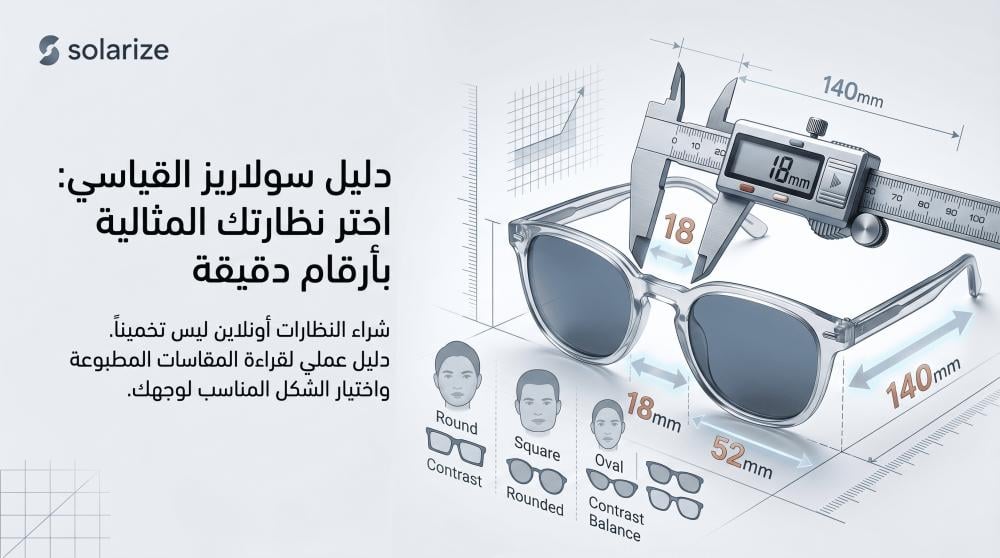
The biggest hurdle anyone faces when buying sunglasses online is the nagging question: "Will they be too wide and slip off? Or too narrow and press against my head? And will the style suit my features?" This apprehension causes many to back out or fall into the trap of choosing the wrong pair, forcing them into complicated exchange and return processes.
At Solaris , we believe that choosing eyeglasses is a science based on measurements and engineering, not luck and guesswork. In this guide, we'll give you the precise technical tools to determine your ideal size and shape from the comfort of your home with over 95% accuracy.
1. Decoding: How do you read the three numbers inside your glasses?
If you have any old glasses at home (sunglasses or prescription) that you feel comfortable wearing, turn them over and look inside (usually on the left temple or bridge of the nose). You will find three numbers printed on them, separated by a small dash or square, such as: 145-18-54 .
These numbers represent the geometric design of the glasses in millimeters (mm) , and here is their meaning in order from left to right:
- Lens width (e.g., 54): This is the horizontal diameter of the widest point of a single lens. It is the most important number for determining whether the glasses will fit your face shape.
- Bridge width (e.g., 18): This is the distance between the two lenses that rest on the nose. If your nose is wide, you need a larger number (from 18 to 21), and if it is narrow, you need a smaller number (from 15 to 17).
- Temple length (e.g., 145): This is the length of the arm extended from the frame to behind the ear. Standard adult temple lengths are typically between 140 and 150 mm.
When browsing any model in the Solaris store, compare these three numbers written in the product details with your comfortable glasses to ensure the fit immediately.
2. The geometric contrast rule: What shape suits your features?
The secret to making glasses look "beautiful and harmonious" on your face isn't about fashion, but rather a simple mathematical principle called contrast . The frame should soften the angles of your face or add structure to a round face.
Here's how to choose a shape based on your face shape:
- Round face: Its features are soft and without prominent angles. Geometric solution: Avoid round lenses altogether, and request frames with sharp angles such as square, rectangular, or cat-eye , as they give your face a sharpness and visual depth that reduces its roundness.
- Square or rectangular face: has sharp angles and a prominent jaw. Geometric solution: soften these sharpnesses by using frames with soft curves, such as round, oval, or aviator glasses , as they soften the harsh angles of the jaw and face.
- Oval face: Characterized by a perfect balance of proportions (length is slightly greater than width). Geometric solution: This face shape is fortunate because most shapes suit it. The only rule here is to maintain proportion; choose a frame whose width is equal to the widest part of your face (not too narrow and not too wide beyond the facial contours).
3. The importance of "overall framework presentation" and how to measure it?
There's a fourth measurement that's rarely discussed despite its crucial importance: the overall width of the glasses (frame width) . If the frame is narrower than your face, it will press against your temples and cause headaches, and if it's much wider, it will make your eyes appear unnaturally close together.
How do you measure your face at home? Stand in front of the mirror and place a regular ruler horizontally directly under your eyes, and measure the distance between your right temple and your left temple (from bone to bone).
- If the distance is less than 130 mm , your face is (small/thin) and small-sized glasses will suit you.
- If the distance is between 131 and 140 mm , your face is (average) which is the standard size for most people.
- If the distance is greater than 140 mm , your face is (wide/large) and you need wide frames with lenses starting from 55 mm and above.
In conclusion
The internet is no longer a barrier to luxury shopping. At Solaris , we provide precise, millimeter-level dimensions for each frame in the product description to help you make a data-driven decision. Always remember: read the numbers on your old glasses, determine your face shape, and choose the frame that best balances your features. Smart shopping means 0% returns.